
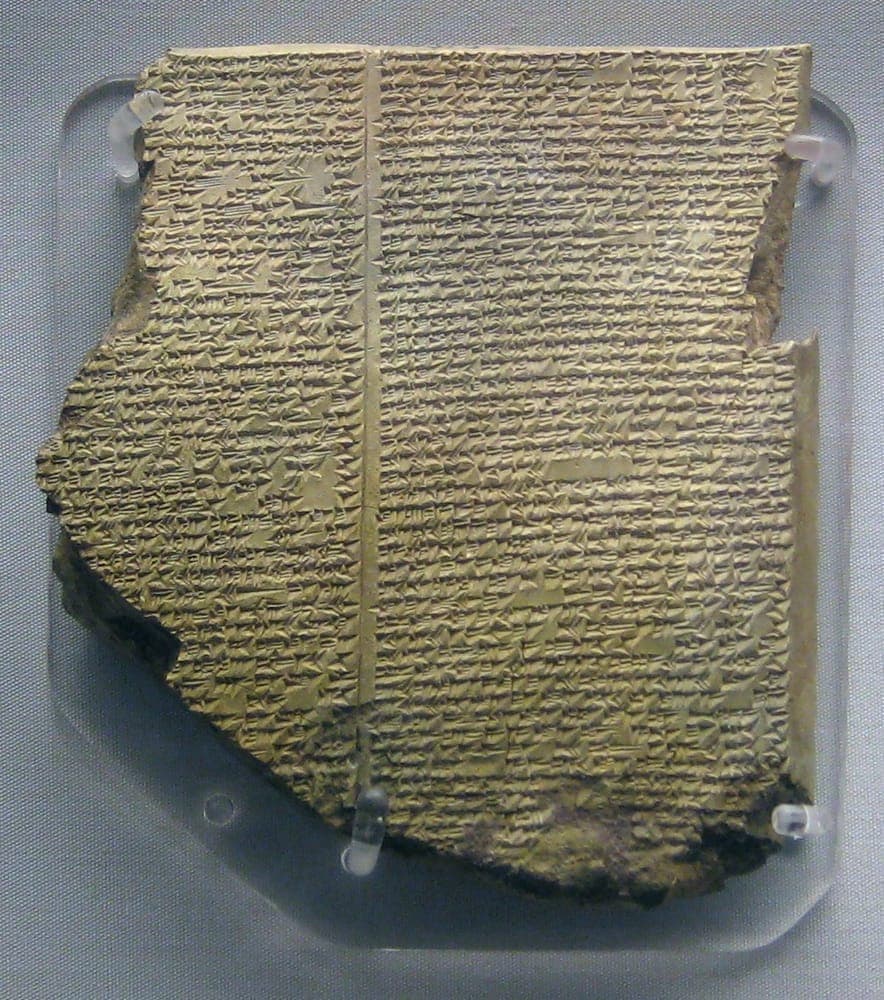
Sumerian and Akkadian · c. 2100 BCE
The Epic of Gilgamesh
By many hands, over a long time.
- Composed
- Composed Mesopotamia
- Survives in
- Survives in Clay tablets
Uruk stood on the Euphrates in what is now southern Iraq, and its walls were famous enough that the poem opens by asking you to walk them and inspect the brickwork. Gilgamesh was probably a real king there, listed among the rulers of Uruk on the Sumerian King List. Within a few centuries of his death he had become a story, and the story had become several. Five separate Sumerian poems about Bilgames survive, some copied as early as the Third Dynasty of Ur around 2100 BCE, and they do not add up to an epic. They are episodes: the cedar forest, the bull of heaven, the death of the king. Scribal students copied them out as writing exercises, which is the only reason any of them are still here. Around the eighteenth century BCE an Akkadian poet took four of those episodes and welded them into one narrative, Surpassing All Other Kings. Only fragments of it survive. Something in the welding worked, because the poem kept being copied, kept being revised, and kept travelling: versions turn up in Hittite and Hurrian, hundreds of miles from Uruk and a thousand years from Gilgamesh. By the time it reached its final shape it had acquired a flood, a boat, a survivor of the flood, and an ending in which the hero fails to become immortal and goes home to look at his walls. It is one of the oldest surviving works of literature, and it was assembled the way a river is assembled, out of everything upstream. Nobody sat down and wrote it. It accumulated for a thousand years, and then it was buried for two and a half thousand more.
The question of who
Sin-leqi-unninni signed nothing. His name reaches us because later Babylonian scribes, cataloguing their own literature, recorded that the standard version of the poem was according to him. He was an incantation priest working somewhere between 1300 and 1000 BCE, and he was not an author in any sense we would recognise. He inherited a poem that already existed and gave it its fixed shape, which makes him one of the earliest editors whose name we know.
How it nearly did not
Nineveh fell in 612 BCE to a coalition that burned Ashurbanipal's palace to the ground, and the roof came down on the library. Clay does not burn. The fire that destroyed the building fired the tablets like pottery, and the collapse buried them, so the poem lasted two and a half millennia because somebody tried to obliterate the place that held it.
Four thousand years
- c. 2100 BCE Five Sumerian poems of Bilgames, sung separately, never as one story
- c. 1800 BCE Surpassing All Other Kings, four of the poems welded into one Akkadian epic
- c. 1200 BCE Sin-leqi-unninni fixes the standard version, He Who Saw the Deep
- 612 BCE Nineveh burns. The library falls., the fire bakes the clay and preserves it
- 1849 Layard breaks into Sennacherib's palace, the floor knee deep in broken tablets
- 1872 George Smith reads the flood tablet
- 2011 Twenty unknown lines of Tablet V surface, bought from a smuggler for eight hundred dollars
- Now Still being read
The first button needs the app on this device; the second gets it there.