
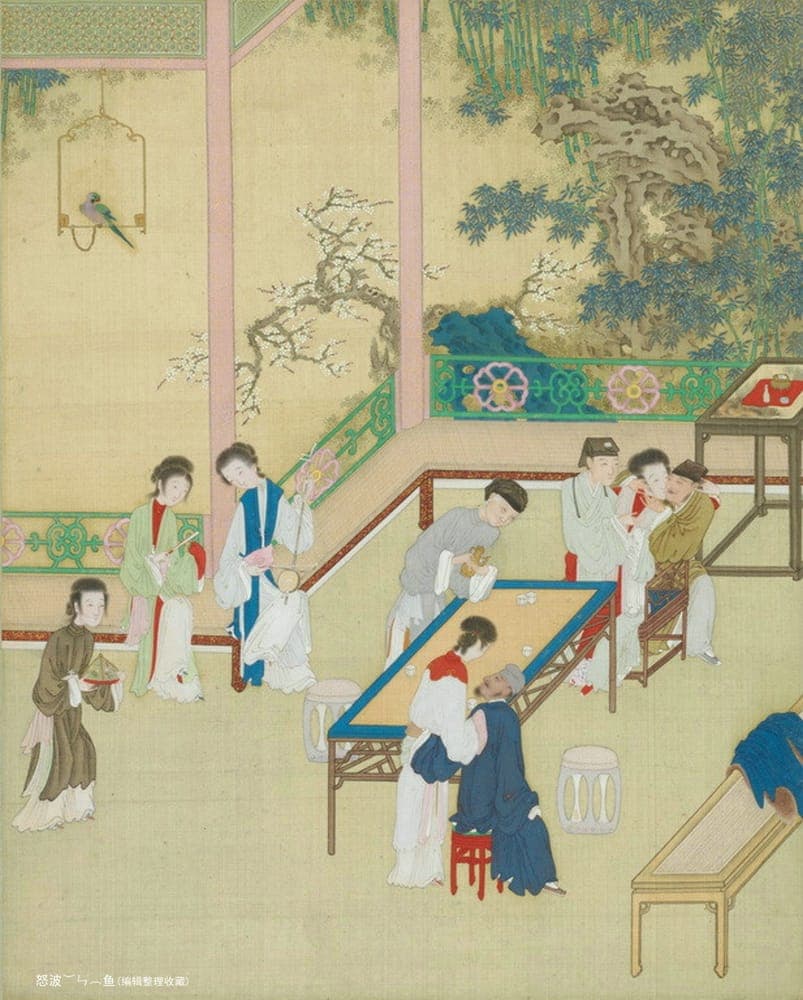
Chinese · late 16th century
The Plum in the Golden Vase
By someone whose name is argued over.
- Composed
- Composed Ming China
- Survives in
- Survives in 4 Ming copies
By the late sixteenth century, Chinese vernacular fiction already had its bandit-heroes, its monk-pilgrims, its dynastic generals. What it did not have was an ordinary household. Jin Ping Mei starts by lifting a single episode from an earlier novel, the Water Margin's account of the adulterous wife Pan Jinlian and the merchant Ximen Qing who helps her poison her husband, and then refuses to let the borrowed hero, the avenger Wu Song, finish the story. Instead it stays in the house. Across a hundred chapters it tracks Ximen Qing's six wives and concubines, his bribes, his silk shipments up the Grand Canal, his aphrodisiacs, and his death from an overdose of the last of them, with no gods, ghosts, or armies anywhere in it, which is why it is often called the first long Chinese novel to invent a fictional world entirely of its own rather than dramatize inherited history, legend, or myth. Its title is built from its three central women, one character each from Pan Jinlian, the concubine Li Ping'er, and the maid Pang Chunmei, so Gold, Vase, and Plum name the book before the story does. It surfaces in the record already written, or nearly so: the essayist Yuan Hongdao, writing to his friend Dong Qichang around 1596, begged to know where he had got his copy and demanded the missing second half. For at least a decade after that it changed hands only as an expensive hand-copied manuscript among a small circle of literati readers in the lower Yangtze delta, prized and lent rather than owned outright, before a Hangzhou printer finally set it in type.
The question of who
Lanling Xiaoxiao Sheng, the Scoffing Scholar of Lanling, signed the novel and nothing else. His only contemporary witness, a preface writer calling himself Xinxinzi, confirmed merely that his friend came from Lanling in Shandong. Since a Qing scholar first proposed the Ming grandee Wang Shizhen, dozens of further candidates have followed, Wang's case resting largely on a since-doubted revenge legend; the novel's own English translator, David Tod Roy, argued instead for the playwright Tang Xianzu. None has won lasting consensus.
How it nearly did not
Banned by name within decades of its first printing, and repeatedly again under the Qing for corrupting public morals, the novel was never suppressed for long. Printers issued bowdlerized clean editions to dodge each ban while complete copies passed privately among readers willing to risk it; after 1949 the Party restricted it to senior scholars rather than destroy it, and it has been reprinted in every generation since.
Four centuries
- By 1596 Circulating hand-copied among Jiangnan literati, Yuan Hongdao begs a friend for the missing second half
- c. 1610-1618 First printed edition, the Cihua text, a Hangzhou printer sets it in type; the exact year is still argued
- 1687 Banned by name in Jiangsu, the first of many bans; each is followed by a reprint
- 1695 Zhang Zhupo's commentary becomes the standard text, a failed examination candidate names it the first book of wonders
- 1933 A buried Cihua copy resurfaces in Shanxi, one of only four originals known to survive
- 1939 First complete English translation, its explicit scenes rendered in Latin, not English
- 1993-2013 David Tod Roy publishes the first unexpurgated English translation, five volumes, thirty years, finished as he was dying of ALS
- Now Still being read
The first button needs the app on this device; the second gets it there.