
Egyptian · c. 1875 BCE
The Tale of Sinuhe
By no one whose name survives.
- Composed
- Composed Egypt
- Survives in
- Survives in Papyrus & ostraca
Egypt in the early Twelfth Dynasty had just weathered its first dynastic murder in generations. Amenemhat I, the general who had ended a century of fragmentation and refounded the monarchy, was cut down by his own bodyguard in his own bedchamber, in year thirty of his reign, third month of the Inundation season, while his son and co-regent Senusret was away campaigning against the Libyans. Out of that unresolved shock the Egyptian court produced two literary answers within a generation. One, the Instructions of Amenemhat, is spoken in the dead king's own voice, warning his son to trust no one. The other is Sinuhe: an official of the royal household who, hearing the news on campaign, panics and flees Egypt entirely, for no reason the text ever fully explains. He crosses into Canaan, is taken in by a local ruler, marries, fights a champion in single combat, grows rich and old among foreigners, and is then, unexpectedly, summoned home by the very king he fled, and forgiven. The story borrows its shape from a genre Egyptians used on real tomb walls, the funerary autobiography, in which the dead recount their honours to visitors, and it breaks that form exactly where Sinuhe breaks faith with Egypt, mending it again on his return. It reads at once as propaganda for royal clemency and as a genuine document of political dread, and Egyptologists do not agree how much distance separates the two readings. What is not in dispute is that whoever wrote it turned a succession crisis into the most copied story Egypt ever produced, recopied for seven hundred years by scribes who had never known Amenemhat's reign at all.
The question of who
No name attaches to Sinuhe at any point in its copying history, not even a later editor's the way Gilgamesh carries Sin-leqi-unninni's. The text presents itself as Sinuhe's own funerary autobiography, a genre Egyptians used on real tomb walls, but no tomb belonging to a Sinuhe has ever turned up, and the story's command of structure argues against a literal transcript. Egyptologists read it as the work of one trained scribe of the Residence, writing within Senusret I's reign, whose name did not survive the copying.
How it nearly did not
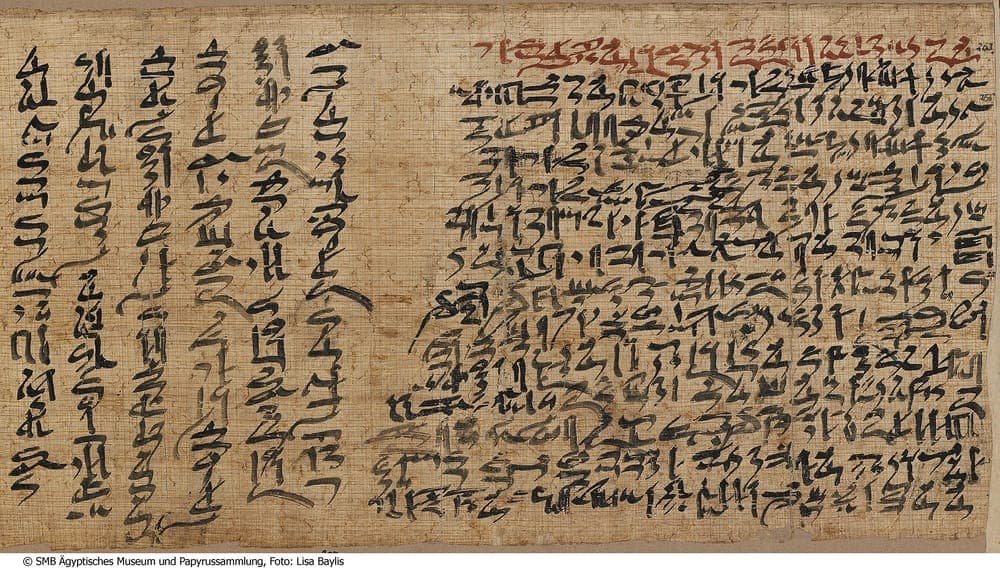
Papyrus Berlin 10499 survived by an accident of neglect. Buried in a wooden box in a lector priest's tomb beneath the Ramesseum, it had already been picked over once by ancient robbers after metal, not writing, then left in ground damp enough that by 1896, when James Quibell opened the box, three quarters of its papyri had rotted to nothing. Sinuhe was in the surviving quarter.
Nearly four thousand years
- c. 1875 BCE Composed early in Senusret I's reign, written within a lifetime of Amenemhat I's murder
- c. 1800 BCE Oldest surviving copy is made, under Amenemhat III, already a set text for scribes
- c. 1700 BCE A lector priest is buried with a copy, sealed in a wooden box beneath the Ramesseum
- c. 1200 BCE Trainee scribes copy it onto broken pottery, New Kingdom students still set it as an exercise seven centuries on
- 1896 James Quibell opens the Ramesseum tomb, the box already robbed once, and three quarters rotted by damp
- 1916 Alan Gardiner publishes the first full translation
- 1952 The Ashmolean's giant ostracon is published, still one of the largest inscribed limestone flakes known
- Now Still being read
The first button needs the app on this device; the second gets it there.