
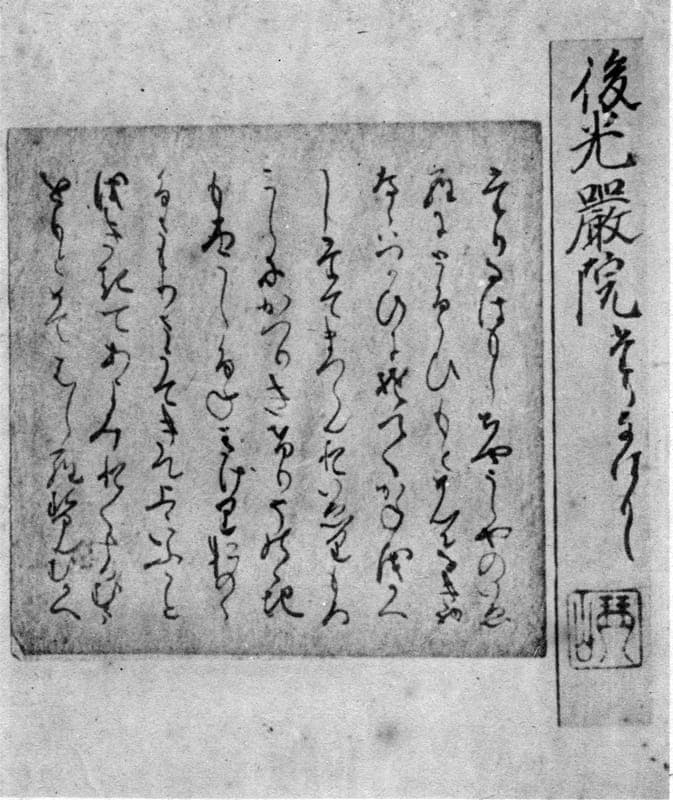
Japanese · c. 900
The Tale of the Bamboo Cutter
By no one whose name survives.
- Composed
- Composed Heian Japan
- Survives in
- Survives in 16th-century copies
In late ninth or early tenth century Heian Japan, at a court whose serious writing was done in Chinese, a new kind of story took shape in kana, the phonetic script that Chinese learning had never required. The Tale of the Bamboo Cutter is the oldest surviving example of that form, the monogatari, and it opens plainly: an old bamboo cutter finds a glowing shoot with a three inch girl inside it, raises her as his own, watches her grow into a woman of unbearable beauty, and loses her when the Moon, her true home, sends a procession down to reclaim her. Around that folk core the writer built something pointed. The five noblemen who court Kaguya hime are set the impossible tasks of a fairy tale, the Buddha's begging bowl, a jeweled branch from a mythical island, a robe sewn from fire rat fur, a jewel plucked from a dragon's neck, a cowry shell from a swallow's nest, but they are also named after five real courtiers of Emperor Tenmu's seventh century court, and every one of them lies, cheats, or is caught out in public. The Emperor of Japan himself, the most powerful man in the country, is refused. The story reaches past Japan too: Kaguya hime's ascent, and the elixir of immortality the Emperor burns on the country's tallest peak rather than live forever without her, borrow directly from Chinese Daoist tales of moon dwelling immortals, grafted onto a native story about bamboo and impermanence. Nobody involved in making it left a name. What survives is a satire dressed as a fairy tale, aimed precisely enough that later readers needed to be told which family it was mocking, and old enough that within a century Japan's greatest novelist would call it the beginning of everything her own book was doing.
The question of who
Nobody signed The Tale of the Bamboo Cutter, and no attribution survives from its own century. Modern scholarship has nominated the kanshi poet Ki no Haseo, the monk poet Henjō, the kana prose pioneer Ki no Tsurayuki, and the scholar official Minamoto no Shitagō, whose birth year of 911 sits awkwardly close to the tale's own date. None commands agreement. Scholars agree only on a profile: a court insider fluent in Chinese learning and the new kana script, with a grudge precise enough to name names.
How it nearly did not
No manuscript from the Heian court survives, not one. The earliest physical trace is a leaf said to be in Emperor Go-Kōgon's hand, copied some four hundred years later; the oldest complete text is a 1592 copy, seven hundred years on. Nothing was rescued from one fire or one ruin. The tale survived by being wanted enough that someone kept recopying it before each old copy wore past reading.
Eleven hundred years
- c. 900 An unnamed court writer composes the tale, the date is fought between the 870s and 920
- c. 1008 The Tale of Genji calls it the ancestor of all tales, in the Picture Contest chapter
- c. 1360 A leaf survives in a hand said to be Emperor Go-Kōgon's, one of eleven leaves, the oldest physical trace
- 1592 Mutō Genshin copies the oldest complete text, corrected again in 1596 against a second manuscript
- 1646 A woodblock edition becomes the standard text, print ends six centuries of manuscript variation
- 1888 F. Victor Dickins publishes the first English translation
- 1956 Donald Keene's scholarly translation appears, revised in 1998 alongside Kawabata's modern Japanese
- 2013 Isao Takahata's The Tale of the Princess Kaguya premieres, his last film before his death in 2018
- Now Still being read
The first button needs the app on this device; the second gets it there.