
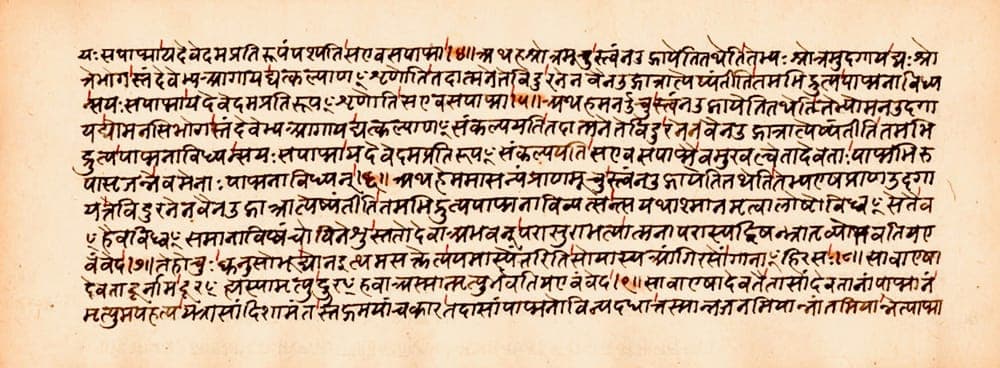
Sanskrit · c. 7th–2nd century BCE
Upanishads
By many hands, over a long time.
- Composed
- Composed North India
- Survives in
- Survives in Memorized recitation
Each of the four Vedas ends the same way: hymns to the gods, then instructions for the priests who sacrifice to them, then forest treatises for those who have left the sacrifice behind, and finally a set of dialogues that ask what the sacrifice was actually for. That last layer is the Upanishads, and Vedanta, end of the Veda, is one of their own names for themselves. The word Upanishad describes a physical arrangement: sitting down close, near a teacher, to receive something not given to a crowd. The earliest of these dialogues, the Brihadaranyaka and the Chandogya, were composed somewhere in the seventh or sixth century BCE, before the Buddha, inside the schools that carried the White Yajurveda and the Sama Veda. They did not stay ritual commentary for long. Teachers speaking inside them, a sage debating his wife, a father instructing his son, turned the old sacrificial questions, what feeds the fire, what the oblation becomes, into a different one: what is the self, and is it the same thing as the reality underneath everything else. More Upanishads followed for four centuries, composed by different schools attached to different Vedas, arguing with each other as often as agreeing, until by around 200 BCE the count in general circulation had grown into the low dozens. None of this happened in a library. It happened in a forest, in a debate hall, in a king's court where sages competed for a prize of cattle by answering harder questions about what survives death than the last man had answered. Centuries later, a tradition that would eventually name 108 of these texts, and set a shorter list apart as principal, was doing to a body of oral teaching what any tradition does once it has outgrown memory: it sorted itself, and kept sorting, long after the last of these dialogues had actually been spoken.
The question of who
No Upanishad names an author, and the dialogue form is why: what survives are teachers caught mid-argument, not writers signing a page. Yajnavalkya debates his wife Maitreyi and instructs King Janaka in the Brihadaranyaka; Uddalaka Aruni teaches his son Svetaketu that self and reality are one in the Chandogya, repeating tat tvam asi, that is what you are, as a refrain. These are named voices inside a text built by many Vedic schools across four centuries, not a single mind's work.
How it nearly did not
For most of their history these texts had no manuscript at all. What kept them intact was recitation: a student memorized a teacher's exact wording, checked syllable by syllable against fellow reciters, and passed the whole corpus on unwritten, generation after generation. The oldest Upanishad manuscript that still exists was copied a full two thousand years after the words in it were first spoken.
Twenty-seven centuries
- c. 7th century BCE Brihadaranyaka and Chandogya take shape, the oldest Upanishads, closing chapters of two Vedic schools
- by c. 200 BCE The classical corpus is largely complete, later texts such as the Katha, Isha and Shvetashvatara follow the earliest two by up to five centuries
- c. 8th century CE Shankara comments on ten, his commentaries fix which Upanishads count as principal
- 13th-14th century The Muktika Upanishad closes the list at 108, a later Upanishad canonizing the corpus by naming itself last
- 1657 Dara Shikoh's Sirr-i-Akbar, fifty Upanishads rendered into Persian, read as the Quran's hidden book
- 1801-02 Anquetil-Duperron's Latin Oupnek'hat, a translation of a translation, and soon Schopenhauer's nightly reading
- 1879 Max Muller's Sacred Books of the East, the first widely read English translation
- Now Still being read
The first button needs the app on this device; the second gets it there.