
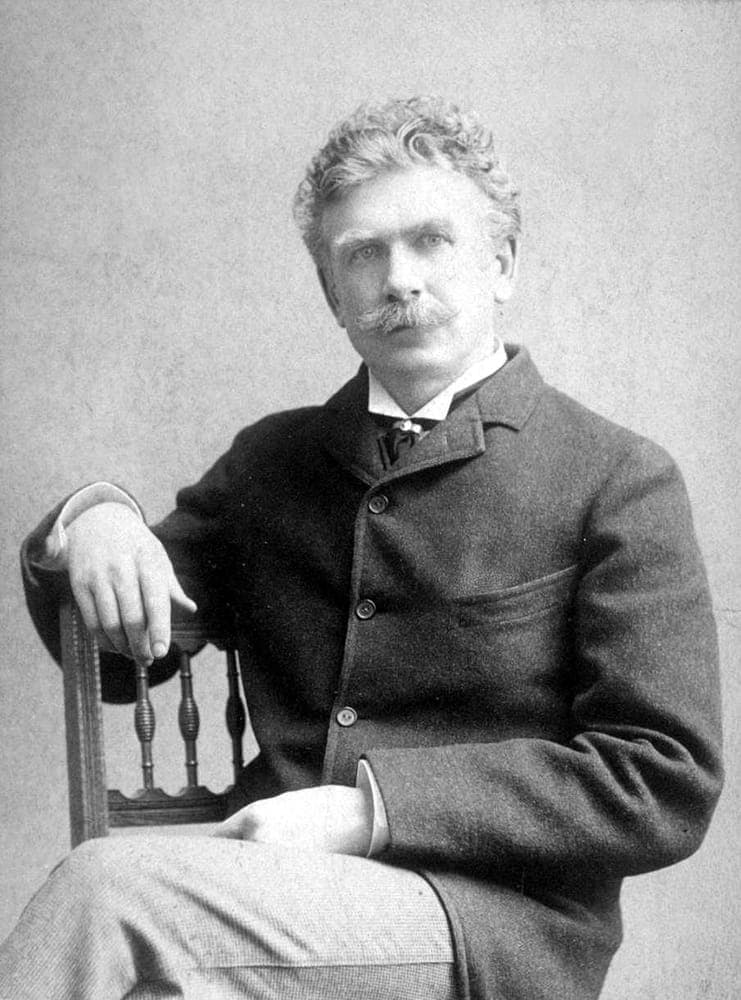
Author
Ambrose Bierce
- Lived
- Lived 1842 to 1914
- From
- From American
- Born in
- Born in Meigs County, Ohio, United States
Born on June 24, 1842, in a log cabin at Horse Cave Creek in Meigs County, Ohio, Ambrose Gwinnett Bierce was the tenth of thirteen children of Marcus Aurelius Bierce and Laura Sherwood Bierce, poor but bookish parents who raised the family in Kosciusko County, Indiana. At fifteen he left home to work as a printer's devil on an abolitionist newspaper, the Northern Indianan. When the Civil War came he enlisted in the 9th Indiana Infantry, fought at Philippi, Rich Mountain, Shiloh and Chickamauga, served as a topographical engineer mapping likely battlefields for General William Babcock Hazen, and in June 1864 took a head wound at Kennesaw Mountain that troubled him for the rest of his life. After the war he crossed the plains with Hazen to San Francisco, left the army with the brevet rank of major, and became one of the best-known journalists on the West Coast, writing for the News Letter, the Argonaut and the Wasp, where his column "Prattle" began, and then for William Randolph Hearst's San Francisco Examiner. He spent 1872 to 1875 in England, where his first book, The Fiend's Delight (1873), appeared under the name Dod Grile. Between 1888 and 1891 he wrote the stories on which his name rests, among them "Chickamauga" and "An Occurrence at Owl Creek Bridge," collected in Tales of Soldiers and Civilians (1891), along with ghost stories that helped pioneer psychological horror. His private life was harder: he separated from his wife, Mollie Day, in 1888, and outlived both his sons, Day, who died in 1889, and Leigh, in 1901. His satirical definitions, gathered in 1906 as The Cynic's Word Book and later retitled The Devil's Dictionary, made his wit a byword. In 1913, at seventy-one, he toured his old battlefields, crossed into Mexico in the middle of the revolution and travelled with Pancho Villa's army. His last known letter is dated December 26, 1913, at Chihuahua, and after it he was never seen again. The year of his death, usually given as 1914, is a presumption, not a record.
In January 1896 Hearst sent Bierce to Washington to fight a bill excusing the railroads from repaying $130 million in federal loans. On the Capitol steps Collis Huntington confronted him and told him to name his price. Bierce answered that his price was one hundred thirty million dollars, payable to the Treasurer of the United States, and the bill was defeated.
The first button needs the app on this device; the second gets it there.
In the canon
- Chickamauga1889
- An Occurrence at Owl Creek Bridge1890
- Tales of Soldiers and Civilians1891
- The Death Of Halpin Frayser1891
- The Devil's Dictionary1906