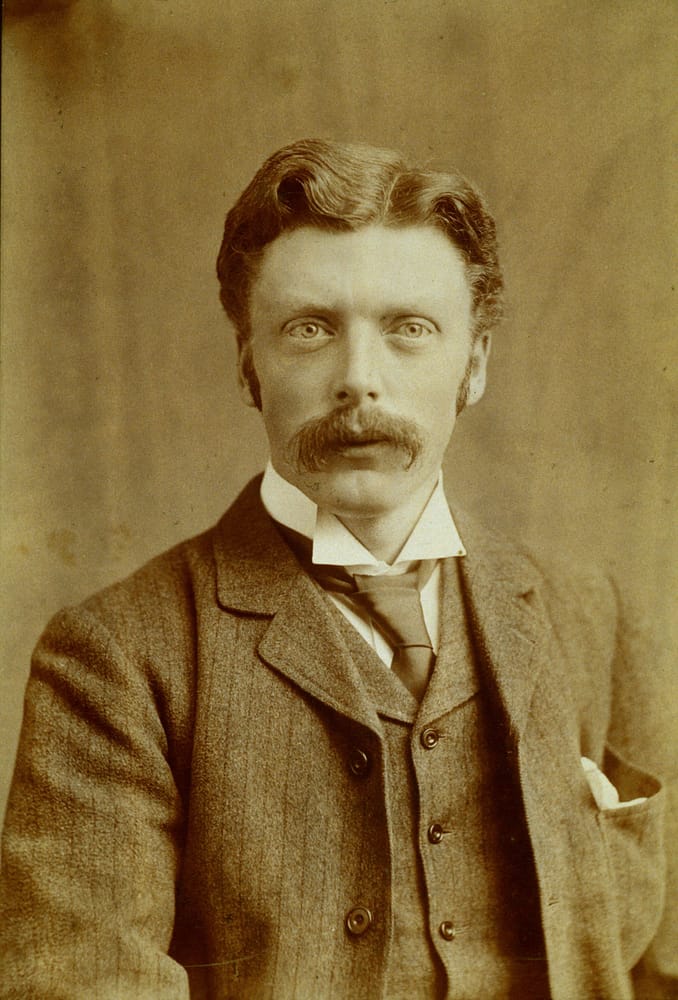
D'Arcy Wentworth Thompson
Scottish · 1860 to 1948
Born D'Arcy Wentworth Thompson on May 2, 1860, in Edinburgh, the son of a Classics master also named D'Arcy Thompson, he lost his mother, Fanny Gamgee, nine days after his birth, and was raised instead by his maternal grandfather, Joseph Gamgee, a veterinary surgeon. He was educated at Edinburgh Academy, studied medicine briefly at the University of Edinburgh, then read zoology at Trinity College, Cambridge, taking his degree in 1883. The following year, at just twenty-four, he was appointed Professor of Biology at University College, Dundee, a chair he held for thirty-two years. In 1896 the British government sent him to the Bering Strait to investigate the collapse of the fur-seal trade, and his findings on the dwindling population helped shape early international protections for the species. A trained classicist as well as a zoologist, he published a translation of Aristotle's History of Animals in 1910, praised for combining exact Greek scholarship with a working naturalist's eye. His best-known book, On Growth and Form, appeared in 1917, arguing that the shapes of living things owe as much to the plain laws of physics as to evolutionary history; he spent much of his eighties, during the Second World War, revising it into a second edition nearly half again as long. That same year, 1917, he moved to the University of St Andrews as Professor of Natural History, a post he kept until his death. He married Maureen Drury in 1901, and they had three daughters. Knighted in 1937 and later awarded the Darwin Medal, he built a zoology museum at Dundee that grew into one of the largest of its kind in Britain, specializing in Arctic zoology, and it still carries his name. He died at St Andrews on June 21, 1948, at eighty-eight, his health broken after a trip to India for a Science Congress in Delhi, and was buried in Edinburgh's Dean Cemetery beside the grandparents who had raised him.
In the canon