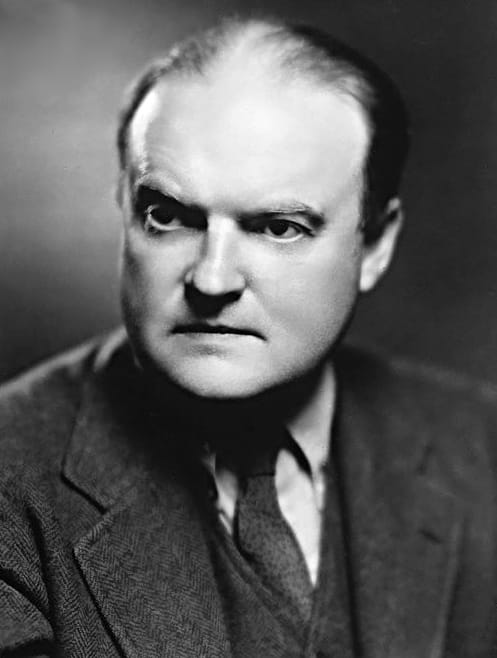
Edmund Wilson
American · 1895 to 1972
Born Edmund Wilson Jr. on May 8, 1895, in Red Bank, New Jersey, the son of a prominent lawyer who served as the state's attorney general, Wilson was educated at the Hill School in Pennsylvania and then Princeton University, where he edited the campus literary magazine and befriended a younger classmate named F. Scott Fitzgerald, who would later call Wilson his intellectual conscience. After graduating in 1916 he served with a U.S. Army hospital unit in France during the First World War, work that included burying the dead and tending the gassed, an experience that hardened his lifelong suspicion of patriotic rhetoric. He returned to New York and rose through the era's great magazines, as managing editor of Vanity Fair, associate editor of The New Republic, and for decades the principal book critic of The New Yorker. Axel's Castle (1931) made his name as a critic of the first rank, and To the Finland Station (1940) traced the intellectual roots of revolution from Michelet to Lenin. His 1946 story collection Memoirs of Hecate County was banned for obscenity in New York for thirteen years, a ban the Supreme Court upheld on a tied vote in 1948. He married four times, most notably to the critic Mary McCarthy from 1938 to 1946, and for a decade refused to file federal income tax in protest of Cold War military spending, an ordeal he later wrote up himself. Patriotic Gore, his sixteen-essay study of the literature of the Civil War, appeared in 1962 to controversy and lasting acclaim, and remains the book by which he is most often remembered. He died on June 12, 1972, at the age of seventy-seven, at Talcottville, his family's stone house in upstate New York.
In the canon