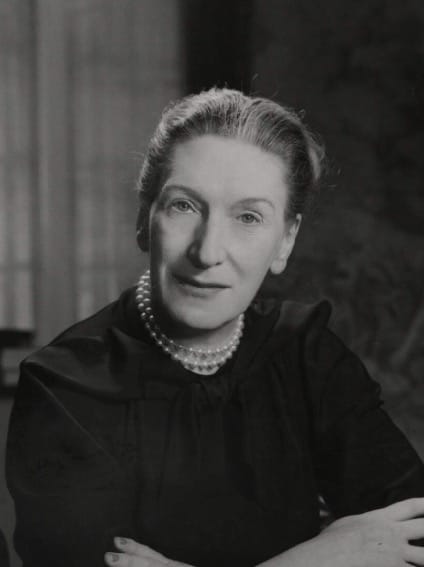
Elizabeth Bowen
Anglo-Irish · 1899 to 1973
Born Elizabeth Dorothea Cole Bowen on June 7, 1899, at 15 Herbert Place in Dublin, she was the only child of Henry Charles Cole Bowen, a barrister, and Florence Isabella Pomeroy, whose family carried titles reaching back to the Viscounts Powerscourt. When her father's mind gave way in 1907, Elizabeth and her mother left Dublin for the English countryside, settling eventually in Hythe, Kent; her mother died five years later, and Elizabeth, thirteen, was passed between aunts for the rest of her adolescence. She was educated at Downe House School, then briefly at art school in London before turning to writing. In 1923 she published her first collection of stories, Encounters, with help from her friend Rose Macaulay, and married Alan Cameron, an educational administrator; the marriage, by most accounts unconsummated, lasted until his death in 1952. In 1930 she became the first woman in her family's history to inherit Bowen's Court, the family estate in County Cork, and divided her life between London and Ireland for three decades. The Last September (1929), The House in Paris (1936), and The Death of the Heart (1938) established her as one of the finest novelists of her generation, prized for a highly wrought, psychologically exacting prose style shaped by literary modernism. During the Second World War she reported to the British Ministry of Information on Irish attitudes toward neutrality, and The Heat of the Day (1949) drew on wartime London's atmosphere of suspicion and loss. Financial pressure forced her to sell Bowen's Court in 1959; it was demolished the following year. She was appointed CBE in 1948 and published her final novel, Eva Trout, in 1968. She died of lung cancer at University College Hospital, London, on February 22, 1973, at seventy-three, and was buried beside her husband in Farahy, County Cork.
In the canon