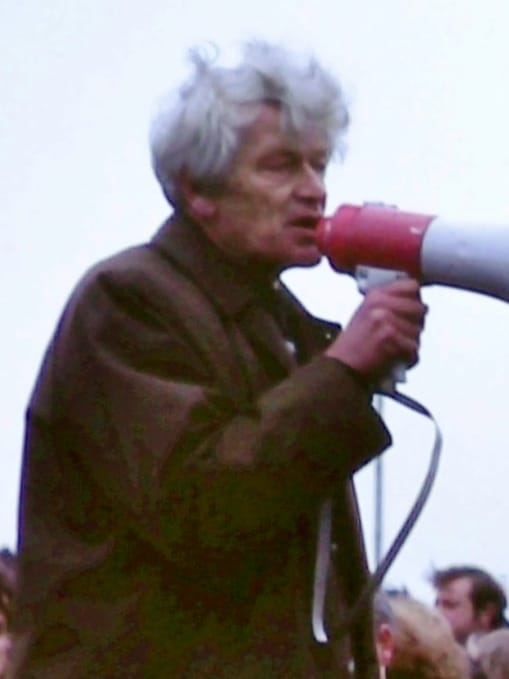
E.P. Thompson
British · 1924 to 1993
Edward Palmer Thompson was born on February 3, 1924, in Oxford, the son of Edward John Thompson, a poet, Methodist missionary, and friend of Rabindranath Tagore who had hoped his son might follow him into writing about India. Instead the younger Thompson left Corpus Christi College, Cambridge, in 1941 to join the Army, commanding a tank through the Italian campaign while his older brother, William Frank Thompson, served as a British liaison officer with Bulgarian partisans. Frank was captured and executed in 1944, at twenty-four, a loss Edward and their mother mourned in the 1947 memoir There Is a Spirit in Europe. Thompson finished his degree after the war, joined the Communist Party of Great Britain, and in 1946 helped found its Historians Group alongside Christopher Hill and Eric Hobsbawm, work that fed the launch of the journal Past and Present in 1952. He married the historian Dorothy Towers in 1948, and for years supported his research by teaching evening extra-mural classes at the University of Leeds. He left the Communist Party in 1956 in protest at the Soviet invasion of Hungary, publishing his first major book, a study of William Morris, the year before. His masterwork, The Making of the English Working Class, appeared in 1963 and remade the field of social history around the lives of ordinary working people. He taught at the University of Warwick until 1971, when he resigned in protest at the university's ties to industry, and spent his later decades writing further history, including Whigs and Hunters and Customs in Common, while becoming one of Europe's leading voices against nuclear weapons through the group he co-founded, European Nuclear Disarmament. He died at his home in Upper Wick, Worcestershire, on August 28, 1993, at sixty-nine, three years before his own account of his brother's final mission was published.
In the canon