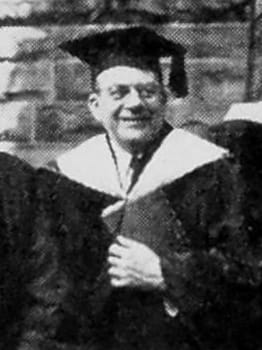
Erwin Panofsky
German-American · 1892 to 1968
Born Erwin Panofsky on March 30, 1892, in Hanover, into a Jewish-German merchant and banking family that had lived in the city for more than a hundred years, he was nicknamed Pan by friends almost as soon as they met him. He began at Berlin University as a law student in 1910, switched to art history, and studied under scholars at Freiburg, Munich and Berlin before earning his doctorate at Freiburg in 1914 with a dissertation on Albrecht Durer's theory of art. He married Dora Mosse in 1916, and the couple raised two sons, one an atmospheric scientist and the other, Wolfgang, a physicist who would later direct the Stanford Linear Accelerator Center. In 1920 Panofsky completed his Habilitation at the University of Hamburg with a study of Michelangelo's compositional principles; the manuscript itself was believed lost for decades until a former student's safe in Munich gave it up again in 2012. Through the 1920s, working alongside Fritz Saxl at the Warburg Library, he developed the method of reading a painting's hidden themes and cultural assumptions that he would later call iconology. The Nazi seizure of power cost him his Hamburg professorship in 1933 on racial grounds, and having already held a visiting post at New York University, he resolved never to return to Germany. In 1935 he joined the newly founded Institute for Advanced Study in Princeton, where Albert Einstein became a friend and where he remained, permanently, for the rest of his career. Studies in Iconology, his best known book, appeared in 1939. Dora died in 1965, and the following year Panofsky married the art historian Gerda Soergel. He died in Princeton on March 14, 1968, at seventy-five, thirty-three years into the single academic post he never left.
In the canon