
Author
Euclid
- Lived
- Lived 325 BCE to 265 BCE
- From
- From Ancient Greek
- Born in
- Born in Unrecorded; his career is placed in Alexandria, Egypt
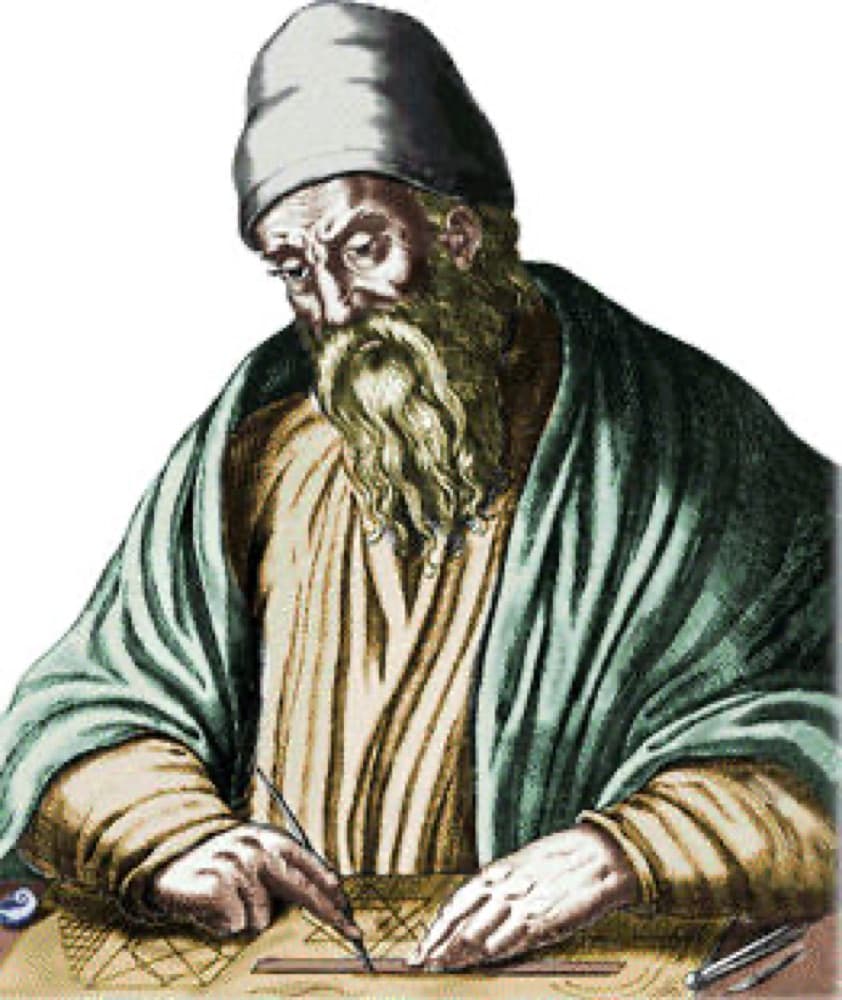
Almost nothing is known about the life of Euclid, and the dates given for him are the conventional guesses of historians, not records. He is placed at Alexandria in the reign of Ptolemy I, who ruled Egypt from 323 to 283 BC, because the philosopher Proclus, writing some seven centuries later, says he was younger than the circle of Plato and older than Archimedes. No ancient source gives his birthplace, his parents, the year of his birth or the manner of his death. The Euclid of Megara who appears on some medieval and Renaissance title pages is a different man, a pupil of Socrates, and the confusion lasted for centuries. What survives is the work. The Elements, in thirteen books, gathers the geometry of his predecessors into a single chain of proofs that starts from a few definitions, five postulates and five common notions, and builds from the equilateral triangle of its first proposition to the five regular solids of its last. It treats plane figures, proportion, the theory of numbers, including a proof that the primes never run out, and the irrational lines that follow from the diagonal of a square. Much of the material was not his own, and his achievement was the order and the rigour, since each proposition rests only on what has already been shown. A few anecdotes cling to him, all recorded long after his death. Proclus reports that when Ptolemy asked whether there was a shorter road to geometry than the Elements, Euclid answered that there is no royal road. Stobaeus tells of a student who asked what he would gain from learning geometry, whereupon Euclid told his slave to give the boy a few coins, since he must profit from what he learns. He also wrote the Data, the Optics, the Phaenomena and a work on the division of figures, and lost books on conics. The Elements was copied through the Greek, Arabic and Latin worlds, first printed at Venice in 1482, and remained the standard school text of geometry well into the twentieth century.
Ptolemy I, the king of Egypt, once asked Euclid whether there was a shorter way to learn geometry than the Elements. Euclid is said to have answered that there is no royal road to geometry. The story comes from Proclus, writing some seven centuries later, and may be legend, but it is the nearest thing to his voice we have.
The first button needs the app on this device; the second gets it there.
In the canon
- Euclid's Elements300 BCE