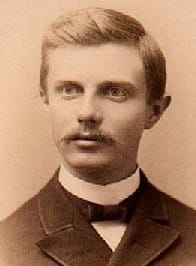
Frederick J. Turner
American · 1861 to 1932
Born Frederick Jackson Turner on November 14, 1861, in Portage, Wisconsin, the son of a newspaper editor and publisher active in Republican politics, Turner grew up in a town at the edge of the old Wisconsin frontier, watching farms and rail lines replace the wilderness his father's generation had settled. He took his bachelor's degree at the University of Wisconsin in 1884 and returned there as a young instructor before completing a doctorate in history at Johns Hopkins University in 1890 under Herbert Baxter Adams, with a dissertation on the Indian trade in Wisconsin. He taught at Wisconsin as professor of history from 1890 to 1910, and on July 12, 1893, read a paper to the American Historical Association, meeting in Chicago alongside the World's Columbian Exposition, that would reshape American historical thought for a century: "The Significance of the Frontier in American History," arguing that the nation's democracy, individualism, and character had been forged less by its European inheritance than by the repeated experience of settling free land at its western edge. In 1910 he moved to Harvard, where he never felt entirely at home but stayed until 1922, gathering the frontier essays and later studies of American sectionalism into The Frontier in American History (1920). He married Caroline Mae Sherwood in Chicago in November 1889; of their three children, only one, Dorothy, survived to adulthood. After retiring from Harvard he took a research post at the Huntington Library in San Marino, California, where his files and note cards accumulated for a decade. He died in Pasadena on March 14, 1932, at seventy. The Significance of Sections in American History, assembled from his unfinished manuscripts, appeared the following year and won him the Pulitzer Prize in History, an honor he did not live to receive.
In the canon