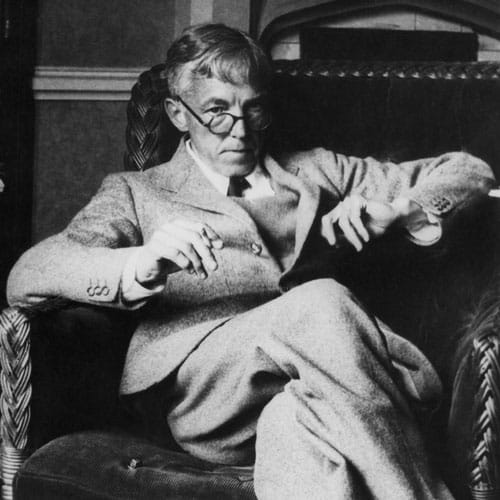
G.H. Hardy
English · 1877 to 1947
Born Godfrey Harold Hardy on February 7, 1877, in Cranleigh, Surrey, the son of a bursar and art master at Cranleigh School and a former mistress at the Lincoln Training College for teachers, he grew up in a household that prized learning but had little money to spare for it. He won a scholarship to Winchester College, where mathematics was the only subject that held him, and went up to Trinity College, Cambridge, in 1896, placing a disappointing fourth in the Mathematical Tripos two years later, a ranking that irritated him for the rest of his life. Elected a Fellow of Trinity in 1900, he spent the next two decades reforming how mathematics was taught in England, importing continental rigor into a system built around competitive exam cramming; his 1908 textbook A Course of Pure Mathematics became the standard introduction to modern analysis for a generation of students. In January 1913 a letter arrived from an unknown clerk in Madras named Srinivasa Ramanujan, covered in theorems Hardy could not classify as either fraud or genius; he brought Ramanujan to Cambridge, and their partnership produced some of the century's most striking mathematics before Ramanujan's early death in 1920. From 1911 Hardy also worked continuously with John Edensor Littlewood in one of mathematics' longest and most productive collaborations, so seamless that a colleague joked there were three great English mathematicians: Hardy, Littlewood, and Hardy-Littlewood. He held the Savilian Chair of Geometry at Oxford from 1920 to 1931 before returning to Cambridge as Sadleirian Professor of Pure Mathematics. A heart attack in 1939 ended both his athletic life and his capacity for original mathematics, and it was out of that decline that he wrote A Mathematician's Apology, a defense of a life spent on work that could never be justified by any practical use. He died in Cambridge on December 1, 1947, at the age of seventy.
In the canon