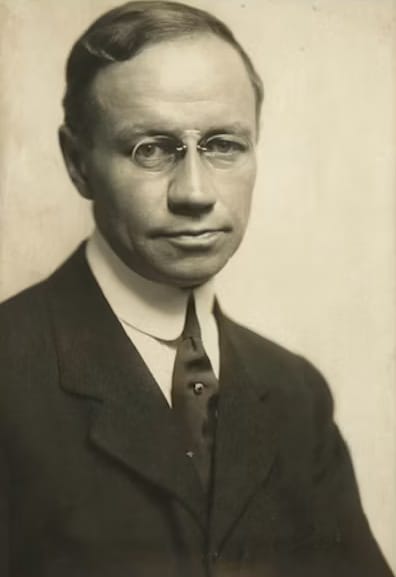
Herbert Croly
American · 1869 to 1930
Herbert David Croly was born on January 23, 1869, in Manhattan, the son of two working journalists: Jane Cunningham Croly, who wrote for decades under the pen name Jenny June, and David Goodman Croly, a follower of Auguste Comte who edited the New York World. He spent a single year at the City College of New York before entering Harvard in 1886, but never finished a degree there. He withdrew twice, once in 1888 to nurse his dying father and once in 1893 after a nervous breakdown, and left for good in 1899 without explanation. In between he married Louise Emory in 1892 and recovered from his breakdown at Cornish, New Hampshire, an artists' colony where he later built a house and counted the judge Learned Hand among his neighbors. From 1900 to 1906 he edited The Architectural Record, then spent the next three years writing the book that would define him. The Promise of American Life, published in 1909, argued that Jefferson's faith in the small, unregulated individual no longer fit an industrial nation, and that only a strong, Hamiltonian national government could deliver the equality Jefferson had promised. The book made Croly, almost overnight, one of the country's most talked-about political thinkers. Theodore Roosevelt read it, befriended its author, and borrowed its arguments for his 1912 New Nationalism campaign. In 1914, backed by Willard and Dorothy Straight, Croly co-founded The New Republic with Walter Lippmann and Walter Weyl, and he edited the magazine into the intellectual home of American progressivism for the rest of his life. The 1920s brought disappointment: the war, the Treaty of Versailles, and the labor crackdowns that followed shook his confidence in the government he had once trusted to reform itself, and an unpublished late manuscript confessed as much. A massive stroke in 1928 left him partly paralyzed and unable to speak clearly. He died on May 17, 1930, in Santa Barbara, California, having sold barely 7,500 copies of the book that had changed how a generation of Americans thought about their own government.
In the canon