
Author
Isaac Newton
- Lived
- Lived 1643 to 1727
- From
- From English
- Born in
- Born in Woolsthorpe, Lincolnshire, England
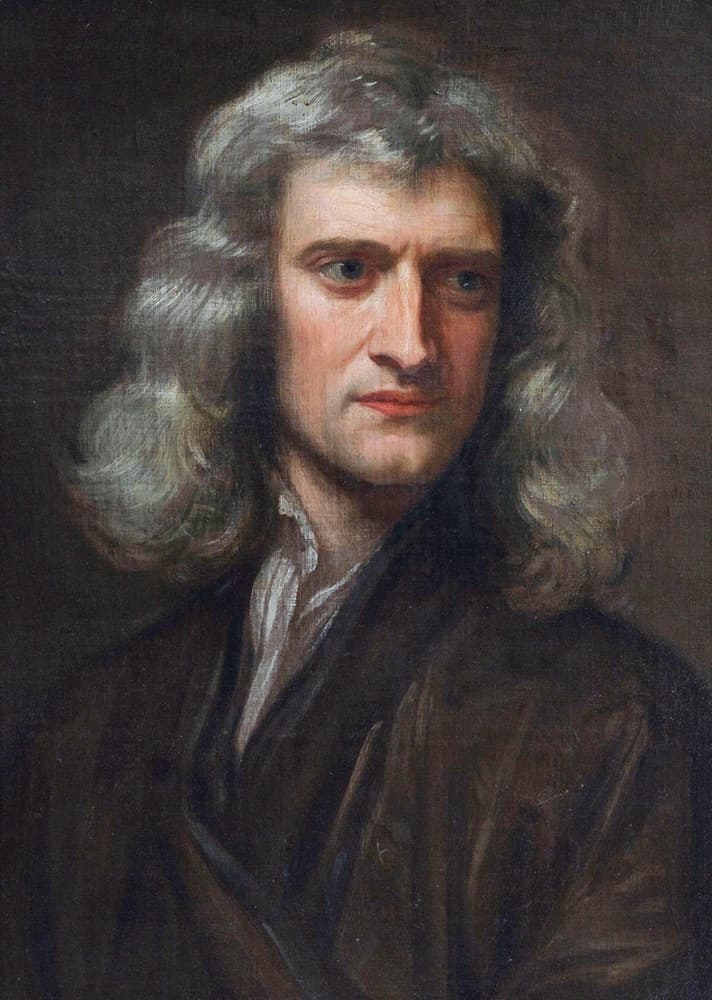
Born on Christmas Day 1642 by the old English calendar, 4 January 1643 by ours, in the manor house at Woolsthorpe in Lincolnshire, Isaac Newton arrived prematurely and three months after his father's death. He was raised largely by his grandmother, studied at the grammar school in Grantham, and entered Trinity College, Cambridge, in 1661. When plague closed the university in 1665 he worked at home for nearly two years, laying the first foundations of calculus, of the theory of colour and of the law of gravitation. He became Lucasian Professor of Mathematics at twenty-six. In 1684 Edmond Halley called on him in Cambridge to ask what path a planet would follow under an inverse-square force; Newton said an ellipse, and Halley urged him to write it out, then helped pay to print the result. The Philosophiae Naturalis Principia Mathematica appeared in July 1687 and gave the world the three laws of motion and the law of universal gravitation. Newton was secretive and quarrelsome, and his disputes with Robert Hooke and Gottfried Leibniz, the latter over who had invented the calculus, ran for years. He sat briefly in Parliament for the university, moved to London in 1696 as Warden of the Royal Mint, and became its Master in 1699, overseeing a great recoinage and pursuing counterfeiters. He published the Opticks in 1704, presided over the Royal Society from 1703 until his death, and was knighted by Queen Anne in 1705. Privately he wrote millions of words on alchemy, chronology and theology, most of them unpublished. He never married. He died in his sleep in London on 20 March 1727, aged eighty-four, and was buried in Westminster Abbey.
In August 1684 Edmond Halley travelled to Cambridge to ask Newton what path a planet would take if the Sun's pull weakened with the square of the distance. Newton answered at once that it would be an ellipse, said he had worked it out years before, and could not find the paper. Halley persuaded him to write it out again.
The first button needs the app on this device; the second gets it there.
In the canon
- Principia Mathematica1687