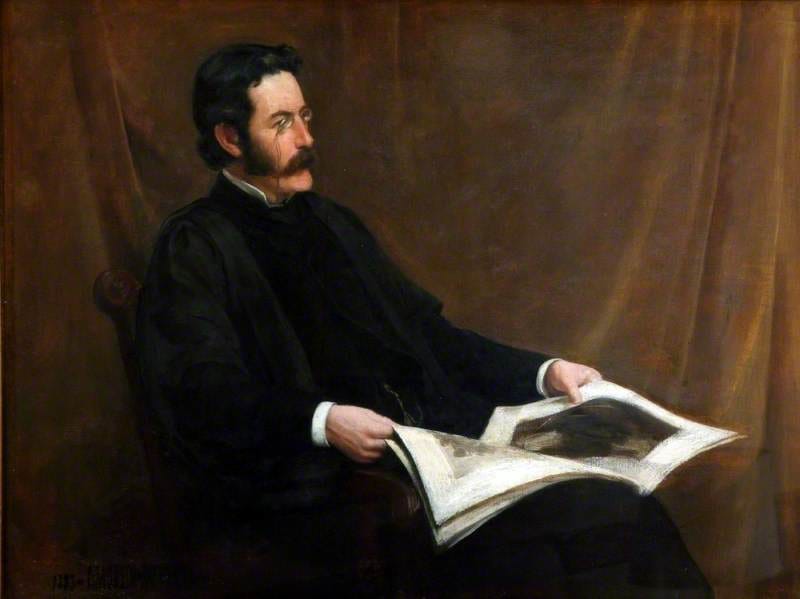
James George Frazer
Scottish · 1854 to 1941
James George Frazer was born on 1 January 1854 in Glasgow, Scotland, the son of a pharmacist. He studied classics at the University of Glasgow before moving to Trinity College, Cambridge, where he took first-class honours and was elected a Fellow in 1879, a position that, with brief interruptions, anchored the rest of his working life. He trained for the bar at the Middle Temple but never practised law; instead, encouraged by the biblical scholar William Robertson Smith and fired by E.B. Tylor's Primitive Culture, he turned toward the emerging discipline of comparative religion. Working almost entirely from his library rather than the field, Frazer drew on missionaries' letters, colonial reports, and a mailed questionnaire to build a vast comparative survey of myth, magic, and ritual across cultures. The first edition of The Golden Bough appeared in two volumes in 1890; it grew, through a second edition in 1900 and a third completed in 1915, into a twelve volume study, with a supplementary volume, Aftermath, added in 1936. In 1896 he married Elizabeth 'Lilly' Grove, a widow and writer who became his closest collaborator and who compiled the popular single volume abridgment of 1922, the version through which most readers came to know the book. Frazer held a one year chair in social anthropology at Liverpool in 1907 before returning to Cambridge, and he was knighted in 1914 and later admitted to the Order of Merit. His theory that human thought moved from magic through religion toward science shaped a generation of writers and thinkers, from T.S. Eliot to Sigmund Freud, even as later anthropologists, working in the field he rarely visited himself, grew sceptical of his methods. Nearly blind in his final decade, he died in Cambridge on 7 May 1941, within hours of Lilly's own death, at eighty-seven.
In the canon