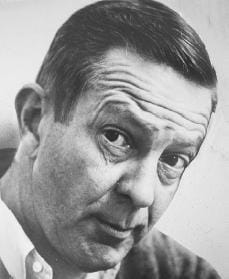
John Cheever
American · 1912 to 1982
John Cheever was born on May 27, 1912, in Quincy, Massachusetts, the younger son of a shoe salesman whose business collapsed in the Depression and a mother who kept the family afloat running a gift shop. He was expelled from Thayer Academy at seventeen for smoking and poor grades, and turned the humiliation straight into fiction: his first published story, 'Expelled,' appeared in the New Republic within months, and he never set foot in a college classroom again. He sold his first story to the New Yorker in 1935 for forty-five dollars and spent the next four decades as one of its defining voices, chronicling the cocktail hours, commuter trains and quiet despair of postwar Westchester with such precision that critics took to calling him the Chekhov of the suburbs. He married Mary Winternitz in 1941 and served in the Army infantry during the Second World War before settling with his wife and three children first in Scarborough-on-Hudson and then in a Dutch colonial farmhouse in Ossining, New York, where he lived for the rest of his life. His first novel, The Wapshot Chronicle, appeared in 1957 after a Guggenheim Fellowship gave him the time to write it, and won the National Book Award the following year. Alcoholism shadowed his middle age and nearly killed him in 1973; he got sober for good at the Smithers clinic in 1975 and went on to write some of his finest work, including the novel Falconer. The Stories of John Cheever, a career-spanning collection published in 1978, sold far beyond what short fiction usually manages and won the Pulitzer Prize the following year. He died of cancer in Ossining on June 18, 1982, at seventy, three years before his daughter Susan's memoir and a later biography revealed the private turmoil, including his lifelong bisexuality, that his elegant, unsettled fiction had always been quietly circling.
In the canon