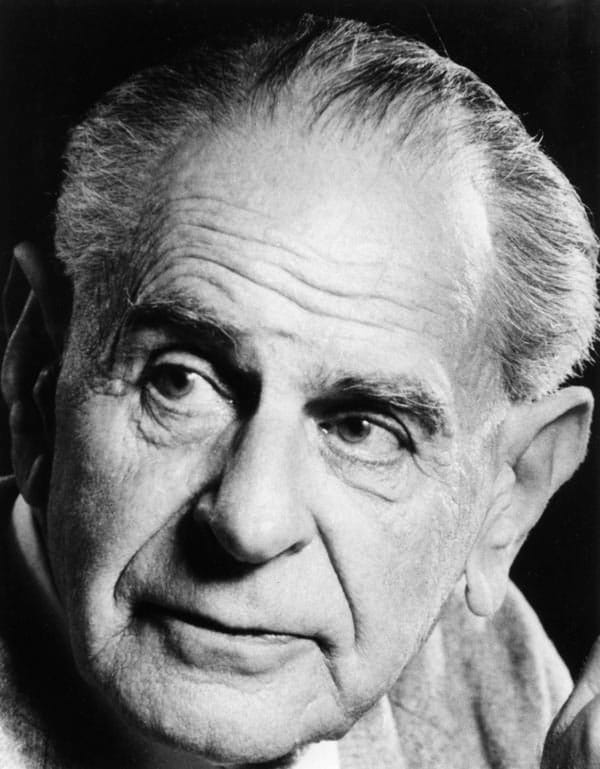
Karl Popper
Austrian-British · 1902 to 1994
Born Karl Raimund Popper on July 28, 1902, in Vienna, into a bookish Jewish family, his father a lawyer with a taste for classics and philosophy, his mother a passionate amateur musician, Popper grew up surrounded by ideas and, after a bout of illness ended his formal schooling, went on to educate himself. He enrolled at the University of Vienna in 1918, trained and qualified as a cabinetmaker, earned a diploma to teach primary school, and did voluntary social work in one of Alfred Adler's clinics for children before completing a doctorate in psychology in 1928 under Karl Bühler. As a young man he heard Einstein lecture on relativity and was struck by the difference between a theory that made a genuinely risky, falsifiable prediction and the psychoanalytic systems around him that seemed to explain everything and risk nothing, a distinction that became the spine of his philosophy of science. He married Josefine Anna Henninger, known as Hennie, in 1930; she worked as his research assistant and typist for the rest of her life, and the couple had no children. Logik der Forschung (1934) introduced falsifiability as the criterion separating science from pseudoscience. After the Nazi annexation of Austria in 1938, Popper, who was Jewish, took a lectureship at Canterbury University College in Christchurch, New Zealand, and spent the war years there writing The Open Society and Its Enemies (1945), a defense of liberal democracy against totalitarian thought that made his name outside academic philosophy. In 1946 he moved to the London School of Economics, where Friedrich Hayek had recruited him, becoming professor of logic and scientific method in 1949 and remaining there until his retirement in 1969. He was knighted in 1965. He died on September 17, 1994, in Kenley, Surrey, at ninety-two.
In the canon