
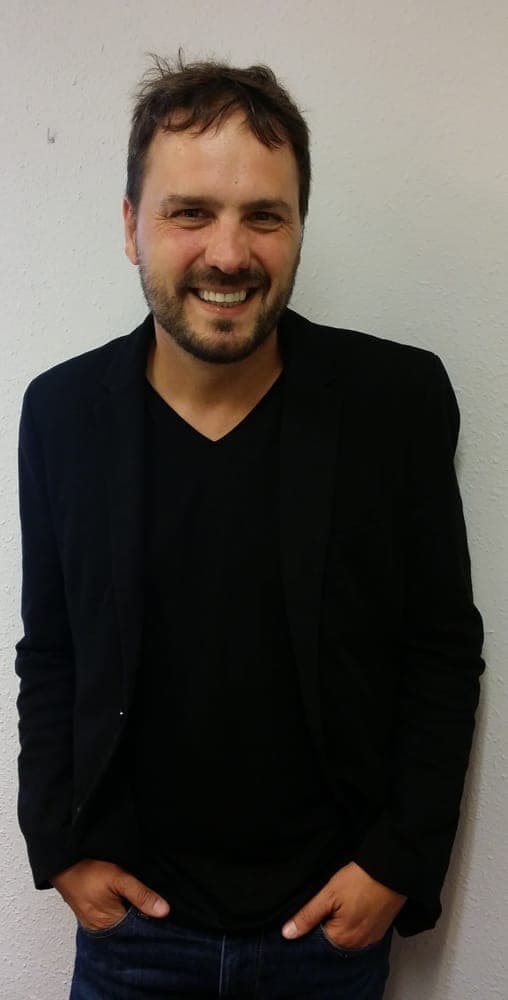
Author
Kirmen Uribe
- Lived
- Lived born 1970
- From
- From Basque
- Born in
- Born in Ondarroa, Spain
Born on October 5, 1970, in Ondarroa, a fishing town on the Bay of Biscay in Bizkaia, into a family of fishermen, Kirmen Uribe grew up speaking a language that had held no official standing for most of his father's life. He read Basque philology at the University of the Basque Country in Gasteiz and went on to graduate study in comparative literature at the University of Trento in Italy. In 1995, while serving a prison sentence for refusing compulsory military service as a conscientious objector, he learned that an essay on the poet Xabier Lizardi, written behind bars with his friend Jon Elordi, had won the Becerro de Bengoa Prize, the first literary award of his life. He worked for years as a translator, carrying Raymond Carver, Sylvia Plath, Anne Sexton, Mahmoud Darwish and Wislawa Szymborska into Basque, and wrote a column for the Basque-language daily Berria. His first poetry collection, Bitartean heldu eskutik, appeared in 2001 and won the Spanish Critics' Prize. Bilbao-New York-Bilbao (2008), his first novel, unfolds entirely during a single flight across the Atlantic while its narrator assembles three generations of his own family out of letters, logbooks and the testimony of anyone still alive to remember, refusing to invent a word. Written in Basque, it won Spain's Premio Nacional de Narrativa in 2009, only the third book in that language to take the prize, after Bernardo Atxaga in 1989 and Unai Elorriaga in 2002, and it has since been translated into more than fifteen languages. Mussche followed in 2012 and Elkarrekin esnatzeko ordua in 2016. He held a Cullman Center fellowship at the New York Public Library in 2018 and 2019, settled in New York, and teaches in New York University's creative writing program in Spanish. His poems have appeared in The New Yorker and The Paris Review.
In 1995, serving a sentence in a Spanish prison for refusing compulsory military service, Uribe received word that an essay he had written behind bars with his friend Jon Elordi, on the poet Xabier Lizardi, had won the Becerro de Bengoa Prize, his first literary honor, awarded to a man still counting down his sentence.
The first button needs the app on this device; the second gets it there.
In the canon
- Bilbao New York Bilbao2008