
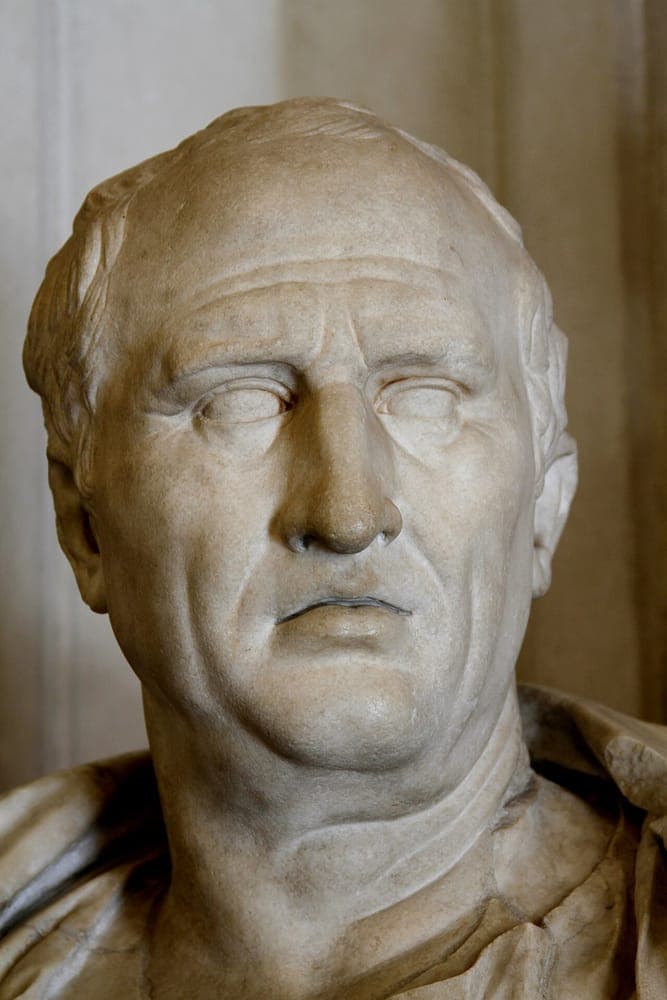
Author
Marcus Tullius Cicero
- Lived
- Lived 106 BCE to 43 BCE
- From
- From Roman
- Born in
- Born in Arpinum, Roman Italy
Marcus Tullius Cicero was born on January 3, 106 BCE, in Arpinum, a hill town southeast of Rome, the elder son of a prosperous equestrian family that had never sent a man to the Senate. He was trained in Rome in law under Quintus Mucius Scaevola, in rhetoric and in Greek philosophy, sat as a young man at the feet of Philo of Larissa, head of Plato's Academy, and later studied in Athens and Rhodes. His defence of Sextus Roscius on a charge of parricide in 80 BCE made him known, and his prosecution of Gaius Verres, the plundering governor of Sicily, in 70 BCE made him the first orator in Rome. A new man with no noble ancestors, he rose through each office at the youngest age the law allowed and was consul in 63 BCE, when he exposed the conspiracy of Catiline in four famous speeches and had five conspirators put to death without trial. It earned him the title father of his country and, five years later, exile. Recalled in 57 BCE, he found himself sidelined by Caesar, Pompey and Crassus, governed Cilicia, took Pompey's side in the civil war and was pardoned by Caesar. Shut out of public life and grieving for his daughter Tullia, who died in 45 BCE, he wrote in little more than two years most of the philosophy that taught Latin to carry Greek ideas, among it On the Nature of the Gods, On Friendship and On Obligations. He had no part in the murder of Caesar, but afterwards led the Senate against Mark Antony in the speeches called the Philippics. When Antony and Octavian joined forces he was proscribed, and on December 7, 43 BCE, soldiers caught him near his villa at Formiae. His letters to his friend Atticus, rediscovered by Petrarch in 1345, helped to start the Renaissance, and his prose remained the model of Latin style for fifteen hundred years.
In 58 BCE, with a law framed against him, Cicero left Rome for exile. His neighbour and enemy Publius Clodius had the house on the Palatine confiscated and pulled down, and on part of the ground raised a shrine to Liberty. Recalled the next year, Cicero landed at Brundisium on 5 August 57 BCE to cheering crowds.
I go no further: approach, veteran soldier, and, if you can at least do so much properly, sever this neck.
The first button needs the app on this device; the second gets it there.
In the canon
- Murder Trials80 BCE
- Cicero's Letters to Atticus68 BCE
- On The Orator55 BCE
- On Government51 BCE
- On Friendship44 BCE
- On Obligations44 BCE
- On The Gods45 CE