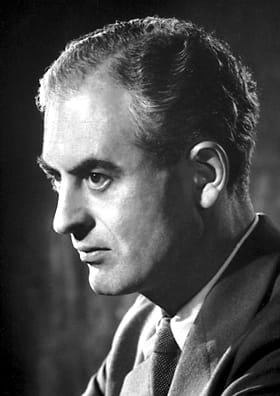
Peter Medawar
British · 1915 to 1987
Born Peter Brian Medawar on February 28, 1915, in Petrópolis, Brazil, to a Lebanese businessman father and an English mother, he moved to England as a boy and was educated at Marlborough College before going up to Magdalen College, Oxford, where he studied zoology under John Zachary Young and graduated with first-class honours in 1935. As a graduate student there he met Jean Taylor, who first approached him to ask what the word 'heuristic' meant, and the philosophy lessons that followed led to their marriage in 1937 and four children. During the war he worked on tissue grafting and wound healing for burned airmen, research that pointed him toward the immune system's tolerance of foreign tissue. In 1951, testing a prediction of Macfarlane Burnet's, he had his colleagues Rupert Billingham and Leslie Brent inject mouse embryos with cells from another strain; the mice grew up accepting skin grafts from that strain, proof that immunological tolerance could be deliberately induced, work that shared the 1960 Nobel Prize in Physiology or Medicine with Burnet and became the theoretical foundation of organ transplantation. Medawar held professorships at Birmingham and University College London before directing the National Institute for Medical Research from 1962 to 1969. Alongside the laboratory he wrote essays and lectures of unusual clarity and wit, collected in The Art of the Soluble (1967), and his 1961 review demolishing Teilhard de Chardin's The Phenomenon of Man made him nearly as celebrated a critic as a scientist. A committed follower of Karl Popper's philosophy of science, he was knighted in 1965. A stroke struck him in 1969 while he was reading the lesson at Exeter Cathedral during a British Association meeting, and though partly paralysed he kept researching and writing, several later books completed with Jean's help. He died at the Royal Free Hospital in London on October 2, 1987, at seventy-two.
In the canon