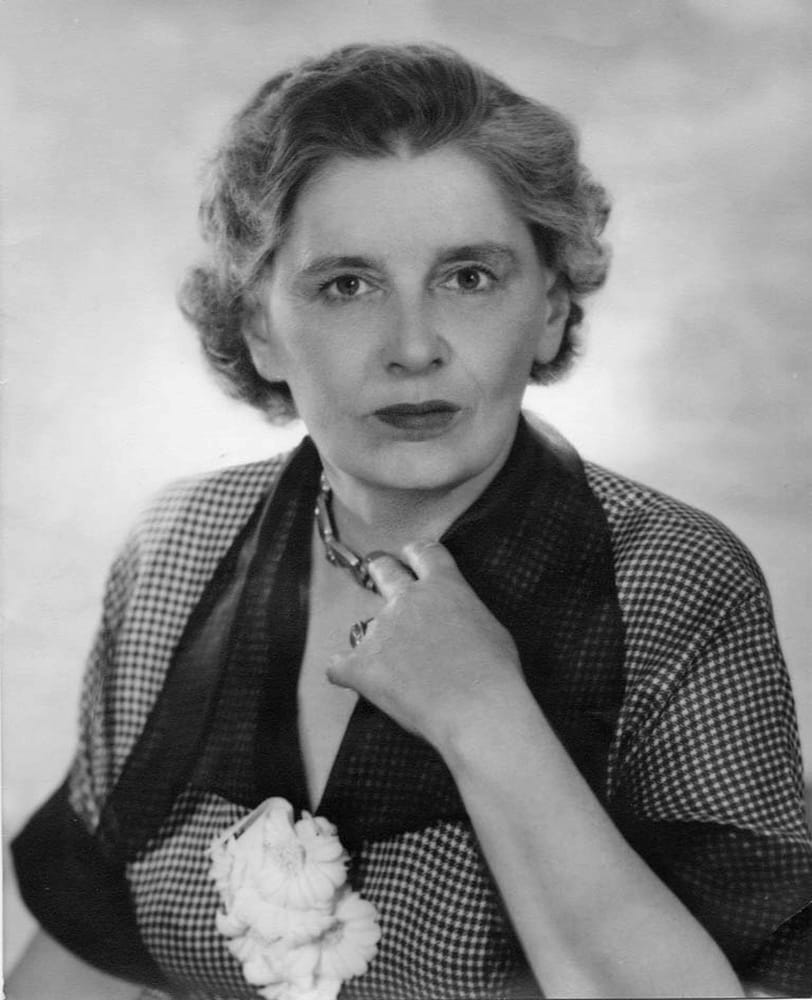
Rebecca West
British · 1892 to 1983
Born Cicely Isabel Fairfield in London on 21 December 1892, to a Scottish pianist mother and an Anglo-Irish journalist father who deserted the family when she was eight, she left school in Edinburgh at fifteen after a bout of tuberculosis and trained briefly as an actress. She took the name Rebecca West from the fierce heroine of Ibsen's play Rosmersholm and used it for the rest of her life. In 1912, writing for the feminist weekly The Freewoman, she reviewed H.G. Wells's novel Marriage so sharply that Wells sought her out. They became lovers within the year, though he was married and twenty-six years her senior, and in 1914 she gave birth to their son, Anthony, beginning a relationship with Wells that lasted a decade and a rift with Anthony that never healed. She married the banker Henry Andrews in 1930, a marriage that endured despite his infidelities and gave her Ibstone, the Chiltern Hills house where she sheltered Yugoslav refugees through the Second World War. Three journeys through Yugoslavia between 1936 and 1938 became the material for Black Lamb and Grey Falcon (1941), the book she called the central work of her life. She went on to cover the Nuremberg trials for The New Yorker and wrote The Meaning of Treason (1947), her study of British wartime traitors, alongside novels including The Return of the Soldier (1918) and The Fountain Overflows (1956). Made a Dame Commander of the British Empire in 1959, she was for decades counted among the finest prose stylists and political journalists writing in English, praised by George Bernard Shaw for handling a pen 'much more savagely' than he could himself. She spent her final years in London, her eyesight failing, and died there on 15 March 1983 at the age of ninety.
In the canon