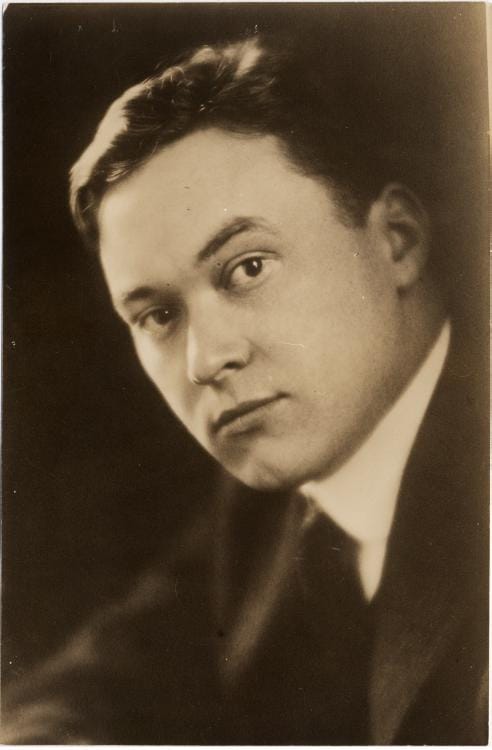
Walter Lippmann
American · 1889 to 1974
Walter Lippmann was born on September 23, 1889, in New York City, the only child of a prosperous German-Jewish family that summered in Europe and gave him an early taste of the wider world. He entered Harvard in 1906, studying philosophy under William James and George Santayana and helping found the Harvard Socialist Club, then left academia for journalism, working briefly as a research assistant to the muckraker Lincoln Steffens and as an aide to the socialist mayor of Schenectady, New York. In 1914, at twenty-five, he co-founded The New Republic with Herbert Croly and Walter Weyl, and the same year published Drift and Mastery, an early attempt to reconcile the disorder of industrial modern life with reasoned social planning. When America entered the First World War he became research director of The Inquiry, the secret board Woodrow Wilson assembled to plan the peace, and helped draft the Fourteen Points before serving as an Army captain attached to the American delegation at Versailles. Public Opinion (1922), his most influential book, examined how the modern citizen actually forms beliefs about a world too vast to see directly, and gave the language the modern sense of the word stereotype. A Preface to Morals (1929) turned the same clear, unhurried intelligence toward religion, asking how a person is to live rightly once inherited faith has dissolved. He spent nearly four decades writing the syndicated column Today and Tomorrow, retiring it in 1967, and his 1961 interview with Nikita Khrushchev won him the 1962 Pulitzer Prize for International Reporting, four years after a special Pulitzer citation for the column itself. He married twice, first to Faye Albertson and later to Helen Byrne Armstrong, the former wife of his closest friend. Lippmann died of cardiac arrest in New York City on December 14, 1974, at eighty-five.
In the canon