
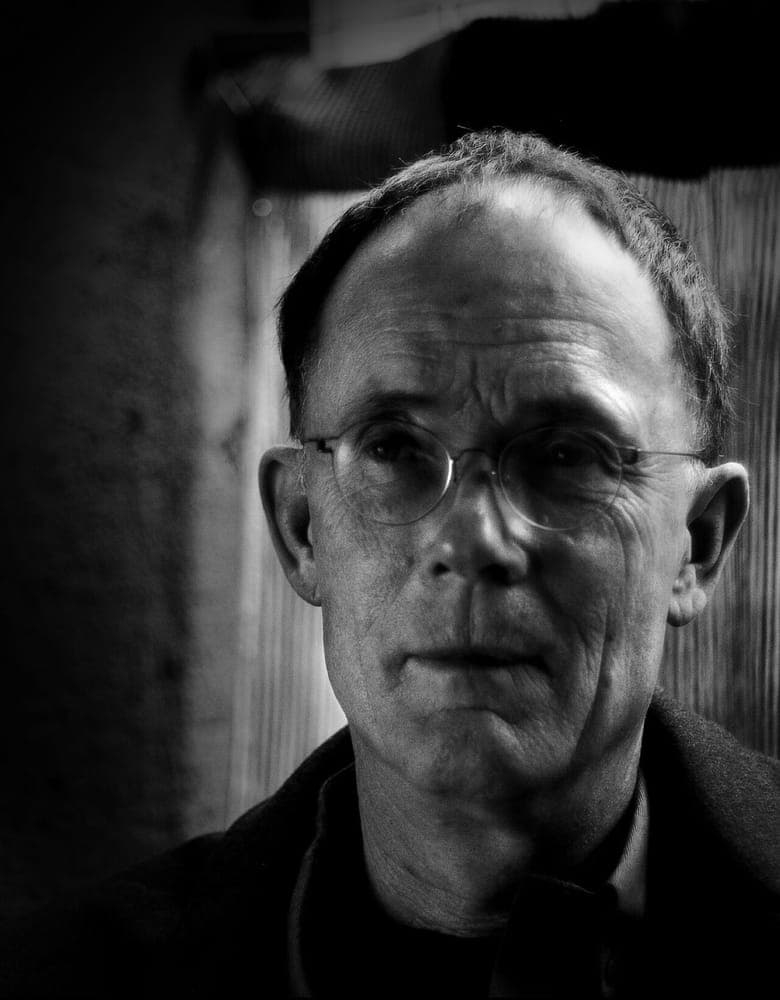
Author
William Gibson
- Lived
- Lived born 1948
- From
- From American-Canadian
- Born in
- Born in Conway, South Carolina
Born on March 17, 1948, in Conway, South Carolina, William Ford Gibson grew up mostly in Wytheville, Virginia, the Appalachian town where both his parents had been raised. His father, the manager of a construction company, choked to death in a restaurant on a business trip when Gibson was a small boy, and the shy, bookish teenager took refuge in science fiction and, at thirteen, in an anthology of Beat writing that brought him to William S. Burroughs. After his mother died when he was eighteen he left his boarding school in Tucson without graduating, and in 1967 he drifted to Toronto with a vague idea of avoiding a Vietnam draft that, as he later admitted, never actually called him. He managed the city's first head shop, travelled through Europe with Deborah Jean Thompson, whom he married, and in 1972 settled with her in Vancouver, where he took an English degree at the University of British Columbia in 1977 and published his first story. Urged on by the writers John Shirley and Bruce Sterling, he wrote the stories of the early 1980s, among them "Burning Chrome" (1982), in which he coined the word cyberspace. His first novel, Neuromancer (1984), became the first book to win the Nebula, the Hugo and the Philip K. Dick awards, and made him the founding figure of cyberpunk, a label he has held at arm's length ever since. Count Zero (1986) and Mona Lisa Overdrive (1988) completed the Sprawl trilogy; The Difference Engine (1990), written with Sterling, helped launch steampunk; the Bridge trilogy followed through the 1990s. After the attacks of September 11, 2001, he turned to the present itself in Pattern Recognition (2003), Spook Country (2007) and Zero History (2010), his first mainstream bestsellers, before going back to the future in The Peripheral (2014) and Agency (2020). He was inducted into the Science Fiction Hall of Fame in 2008.
Gibson wrote Neuromancer on a 1927 olive-green Hermes portable typewriter, having never touched a computer. A third of the way in, he saw the first twenty minutes of Blade Runner and decided his book was sunk, since everyone would assume he had copied the film's look. He rewrote the first two-thirds twelve times.
The first button needs the app on this device; the second gets it there.
In the canon
- Neuromancer1984