William H. McNeill
Canadian-American · 1917 to 2016
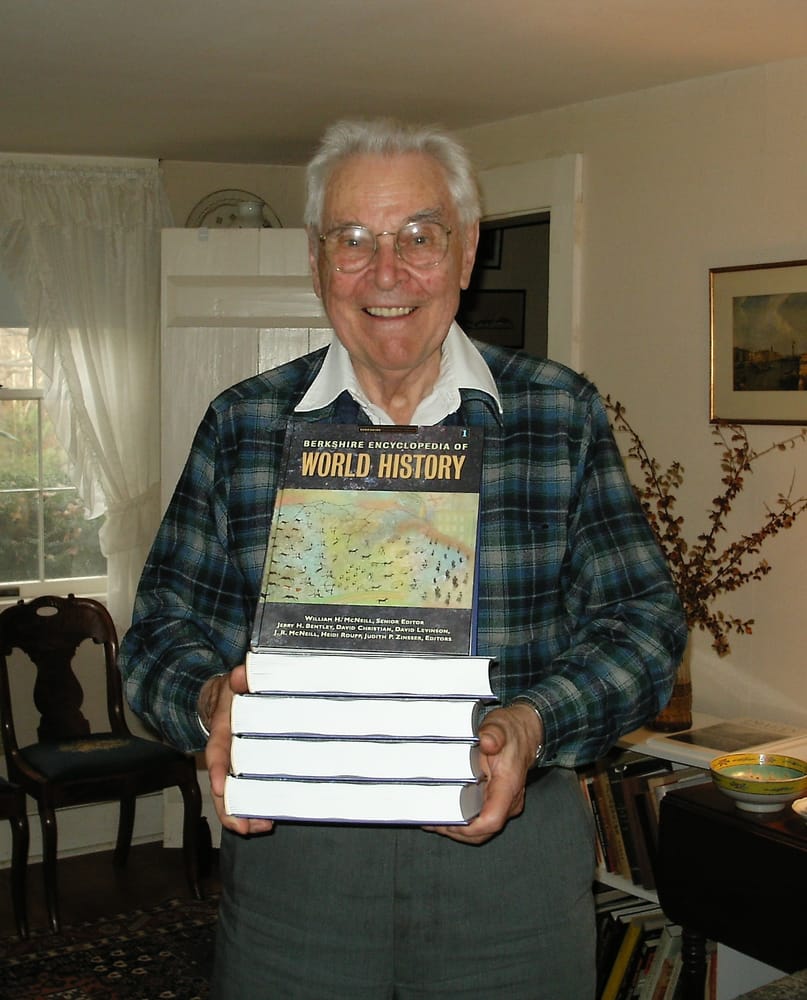
William Hardy McNeill was born on October 31, 1917, in Vancouver, British Columbia, and grew up in Toronto and then, from the age of ten, in Chicago, spending boyhood summers on his family's potato and dairy farm on Prince Edward Island. He graduated from the University of Chicago in 1938, where he edited the student newspaper, the Chicago Maroon, and earned a master's degree there in 1939 with a thesis on Thucydides and Herodotus before beginning a doctorate at Cornell under the historian Carl Becker. World War II interrupted his studies: drafted into the Army in 1941, he served in coast artillery in Hawaii just after Pearl Harbor, then commanded artillery batteries in the Caribbean until a chance meeting with a Cornell professor in a Puerto Rico mess hall got him reassigned as assistant military attache to the exiled Greek and Yugoslav governments in Cairo, where in 1944 he met Elizabeth Darbishire, whom he married in 1946. He finished his Cornell doctorate in 1947 with a dissertation on the potato in Irish history and joined the University of Chicago faculty that same year, remaining there for four decades and chairing the history department from 1961 to 1967. Inspired by Arnold Toynbee's A Study of History and by his own undergraduate teacher Robert Redfield, McNeill spent the 1950s building his own account of world history around contact and exchange between societies rather than Toynbee's separate, self-contained civilizations. The result, The Rise of the West, appeared in 1963 and won the National Book Award. He went on to write more than twenty books, among them Plagues and Peoples and The Pursuit of Power, served as president of the American Historical Association in 1985, and received the Erasmus Prize and a National Humanities Medal. He retired in 1987 to Colebrook, Connecticut, where he took up vegetable gardening, and died on July 8, 2016, at the age of ninety eight.
In the canon