
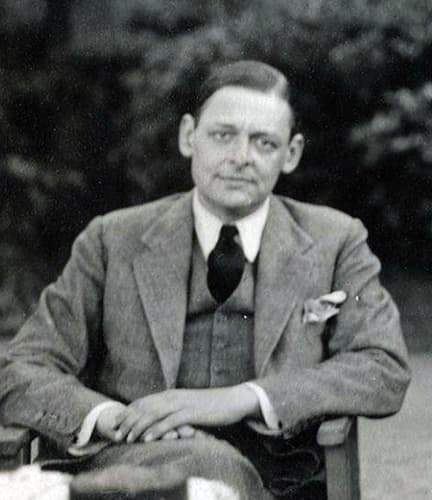
In the Library
The Love Song of J. Alfred Prufrock
T.S. Eliot, 1915
- Form
- Form Poem
- Difficulty
- Difficulty Moderate
- Reading time
- Reading time 5 minutes
- Chapters
- Chapters 1
- Length
- Length 1k words
£1.99
Read in the app, yours for good. Not yet by post.
The book unlocks on your account as soon as you buy it, so the 14-day right to cancel ends once it is unlocked.
In the public domain in the United States only: this edition is sold and read there and nowhere else.
I have measured out my life with coffee spoons;
What buying means
- Yours for good, on every iPhone you sign in to.
- Read in the app’s own reader, with the original beside the translation where there is one.
- Downloaded, so it reads with no signal.
- The same price as in the app. Folio already opens every book on this shelf; buying keeps this one after Folio ends. A refund takes it back.
If you like this, try
The Waste Land
T.S. Eliot
Eliot expands Prufrock's paralysis to an entire civilisation, and the coffee spoons become a heap of broken images.
£1.99
Notes from the Underground
Fyodor Dostoevsky
Dostoevsky's narrator is Prufrock without the drawing rooms: the same self-consciousness, the same inability to act.
£1.99
Mrs Dalloway
Virginia Woolf
Woolf gives Prufrock's interior monologue to a woman who actually goes to the party.
£1.99


About the book
Let us go then, you and I: the poem opens like an invitation, the evening spread above the half-deserted streets like a patient etherised upon a table. What follows is the inner weather of a man circling one overwhelming question he cannot bring himself to ask, deferring it past the toast and the tea, past the women who come and go talking of Michelangelo, until the asking has become impossible. Every reader who has stood at a doorway polishing the perfect sentence and then walked away having said nothing recognises him exactly. It is built almost entirely of dread: the thinning hair noticed by others, the coffee spoons in which a whole life is measured out, the eternal Footman holding the coat and snickering. T.S. Eliot wrote it barely out of his early twenties and somehow already knew how a self can congeal into gesture. The verse that opened modern poetry ends among mermaids singing far out at sea, a music he is certain is not for him, and the soft horror of waking into the ordinary and going under.